
One day when we were wandering local Kunming markets and tea shops , we came across a beautiful pottery called “Hei Gu Tao” which would be in translation as a ‘Black Ancient Pottery’ .

We found the black UFO shaped disks as a very good idea for storing pu-erh tea cakes and big jars for storing loose tea leafs. The main advantage of this pottery is actually the weight . It’s very light, compare to other clay made pottery. Lifting up the big jar feels like it’s made of some hard plastic but not the fired clay.


We spent a some time to track down the place of production ( although it’s not the original place where this pottery technique was invented ) and decide to take a shopping trip. The small town located in the middle of the mountains of Puer area , between Wu Liang and Ai Lao mountains.
There are 3 main roads from where is this place accessible and how “lucky” we are, all of them are in reconstruction 🙁 We are taking the way from Simao which is completely closed so have to go around ( via Menghai route ). That changes original travel time from 3.5hrs to 6.5 hrs by small local bus. And leaving from there after , head to north, that takes another 8hrs. Siran is not happy and suggesting to change it for trip to Menghai instead, so we could find some nice shu pu-erh at least. I feel like this obstacle is for purpose and have good feeling in gut that we gonna find something cool.

Completely exhausted arriving late afternoon to this small sleepy town where economy stopped due to the hard accessibly and no people on the streets gives a feeling not being in China at all.


Surrounding mountains and small river with park aside makes this place very relaxing. Direction signs for tourists and typical cultural billboards are revealing original intention of supporting local economy , but the new highway which is till being build ( almost 3 years now ) from Simao and should eventually bring some “food flow” , is still not finished.


Giving a short stroll trough the town, trying to find some shop selling the black pottery. We have found only one. There are also not many tea shops around either.


As we learned later , despite the surrounding tea mountains , this is not the place where people would buy some tea in shop because they go directly to the farms.

Next day we are asking locals for the place where this kind of pottery is made and getting one simple direction along the river. Arriving in small village located at the edge of the town after few minutes walking entering the gate of the small manufacture.
Boss is not there but workers seem to be busy, mainly the one in the courtyard which was the initial disappointing finding. The truth behind the beautifully satin black pottery.

We finding out that they use coal during the low heat processing in old brick kiln to achieve this black color right after the burning stage in the modern gas kiln where the necessary higher temperature is reached.

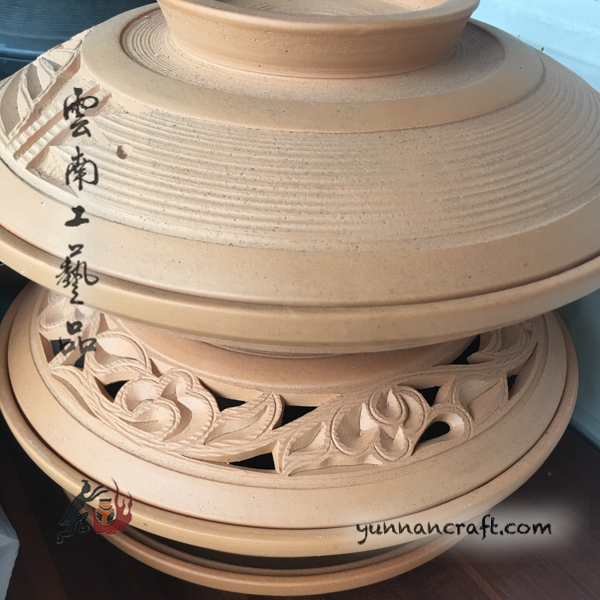
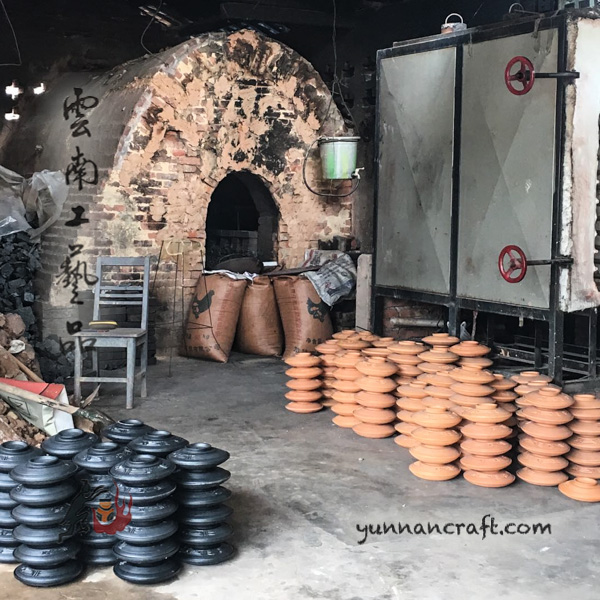

As we are aiming on tea business and tea related pottery , we don’t feel it would be safe / healthy to use this type of clay for storing or brewing the tea in it.
After boss arrives we are invited into the exhibition shop where all those beautiful jars or tea cake storage pottery are presented , but we already know that is just wasting of time for us. All dreams about to offer our customers / tea drinkers something unique , has been shattered into the thousands pieces.

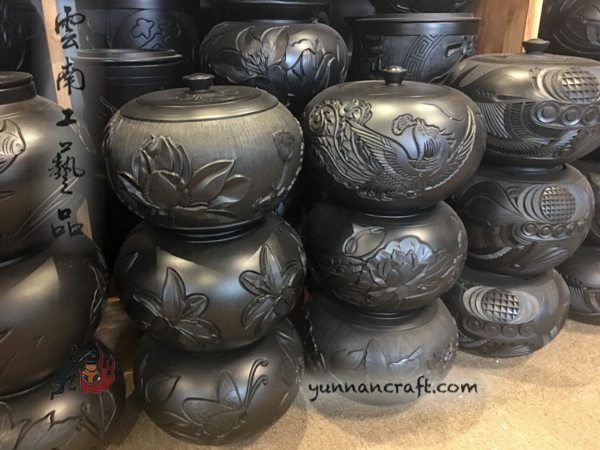


I’m curious and checking other stuff like the tea cups. I’m told that can’t put very hot water in to it 🙂 Boss says it can break because the material just doesn’t cope well with sudden high temperature. As we later research on dedicated websites, we learn that actual problem is, that coal dust could get released into the water because it’s not well compounded with the clay it self.


They also have some pottery pieces made without coal in just simple yellow-white plain clay color, but there is nothing impressive to bother with. Also we know the wholesale prices from other source and boss gives us triple price tag on each item ( we were asking only from curiosity at that stage anyway ) without any space for negotiations.
As we could see their work flow, and heard about the new shop being opened in Kunming, we can expect those things to appear in larger scale soon.


There are two families who are involved into the local pottery production , so we decided to visit the second one as well. Second master has more color / design varieties but since we saw the technique of processing, we are hold on with decision to buy anything.
What we found unique on this “silver” pottery is that it’s hard to break. Woman just purposely dropped the cup on the concrete floor from her hand and nothing happened, just dropping steel sound like. The side pictures of the broken jar’s lid where the silver coating wasn’t done properly.


After longer research on Chinese internet we have found an article claiming that back in 80’s some company ran a test on black pottery ( but made in different province ) and didn’t find any health issues ( any substances dangerous to the human body ) , however we decided to “put this to the ice” until we learn more about Yunnan Hei Gu Tao …Yunnan Black Pottery.

Additional pictures from local park


